

Homeopathic Awareness
TALKS ON CLASSICAL HOMOEOPATHY PART III DISCUSSIONS with George Vithoulkas
MELANOMA
Question: There is a very interesting case which I wonder if we could bring up about melanoma. Answcr: This was a patient who was basically treated for a petit mal epilepsy. [gave her Nat-m. and the petit mat epilepsy went away. I didn't see her again for about live months. She came back in and said that a friend of hers had seen a mole on her skin. She went to a dermatologist and had it taken off; a biopsy revealed a melanoma. The mole had been there for a long period of time. Then they did a very wide excision of this melanoma. The petit mal epilepsy came back. What would that mean as far as direction ? George . This is what usually happens. She would be feeling better if she was taking milk. That is an interesting question to ask. In those cases that get better with milk, they have a great desire for milk. When the gravity of the disease goes to the physical body completely and that is not allowed to the skin - it is suppressed. The melanoma is not a cancer. It is a malignant ulcer which if it is operated upon might cause a metastasis, usually to the brain. Question : The fact that she got her petit mal epilepsy back is a good sign for her then ? George : Yes, read more [...]
The 10 Miasm System – Derived from Rajan Sankaran Miasm System
(Derived from Rajan Sankaran, System of Homeopathy & An Insight into Plants vol I)
One of the most contentious of our theories, one of the most difficult concepts for practitioners to put into practice. Many homoeopaths abandon the idea of miasms as not being useful to them, or being too hard to use in practice.
This also means that in order to try and understand it, the theory has been altered since Hahnemann's day. There are now several models of Miasm.
Hahnemann said that attending to the Miasm was of utmost importance in curing Chronic disease. However due to the confusion over how to classify remedies, how to determine the miasm, it was not adopted by all homoeopaths.
It is often one of the most difficult concepts to teach to students. I have probably found it to be the single most challenging aspect of training - and have tried many different ways to teach it. Some did not work, and some did. In fact I would say that lecturing actually helped me to come to a better understanding of it. Faced with the questions, lack of comprehension, and sometimes frank disbelief of aspiring homoeopaths, it forced me to look at how I applied miasmatic theory in clinic.
We read more [...]
Homeopathic Rubrics of spring season from all the major repertories – Dr Devendra Pal Singh
 I have collected rubrics of spring season from all the major repertories. And I wish you all study them deeply. So that when patient comes to you in this season with complaint of dysentery so you better be prepared that you have to consider kali. bi.
Now we all are familiar with spring coryza of allium.cepa, and autmnal dysentery of colchicum. we must think why season used as a symptom by our stalwarts, !!!!Because in both clinical and drug proving they found affinity of certain drugs towards particular seasons with associated complaint.
For eg vertigo in spring season apis is only medicine. In this season you will have complaints of both acute and chronic like vertigo, asthma, cough, skin eruptions, coryza, dysentery, fever, toothache, facial neuralgia, diarrhea, hoarseness of voice, weakness, stomach ulcers, rheumatism and many more.
I give a case example, a chronic patient of asthma ive tried everything but failed ars, nat.s, tub, sambucus but last year he presented with dysentery in spring season and what happened was after kali.bi dysentery was gone and also the asthma.
Some times acute phase demands the medicine of inner vitality which will lead to cure.
Some read more [...]
I have collected rubrics of spring season from all the major repertories. And I wish you all study them deeply. So that when patient comes to you in this season with complaint of dysentery so you better be prepared that you have to consider kali. bi.
Now we all are familiar with spring coryza of allium.cepa, and autmnal dysentery of colchicum. we must think why season used as a symptom by our stalwarts, !!!!Because in both clinical and drug proving they found affinity of certain drugs towards particular seasons with associated complaint.
For eg vertigo in spring season apis is only medicine. In this season you will have complaints of both acute and chronic like vertigo, asthma, cough, skin eruptions, coryza, dysentery, fever, toothache, facial neuralgia, diarrhea, hoarseness of voice, weakness, stomach ulcers, rheumatism and many more.
I give a case example, a chronic patient of asthma ive tried everything but failed ars, nat.s, tub, sambucus but last year he presented with dysentery in spring season and what happened was after kali.bi dysentery was gone and also the asthma.
Some times acute phase demands the medicine of inner vitality which will lead to cure.
Some read more [...] The Essence of Materia Medica: George Vithoulkas
Aethusa cynapium (aeth.)
The chronic type
Individuals who feel apart.
Strong emotions but do not express them easily. Moved to tears but do not actually cry - emotions felt inside (Unlike Ignatia - moved to tears but constricted at throat so doesn't cry).
Own emotional world - very intense.
Live happily by themselves, but also enjoy company.
Talk to themselves.
Sleep
Intensity comes out in sleep - sleepwalks.
Deep sleep on either left or right side.
Salivate during sleep.
"FEAR of closing eyes lest should never wake". - Kent.
Agg. darkness - do not like darkness - fear will not wake up again. Feel as if suffocating from darkness - have to open window
(Lachesis, Grindelia).
Cannot control the breathing - have to get up, (Ignatia - fear will never sleep again).
Fear of not waking up after an operation.
Extra notes
Crazy for animals, cats and dogs etc - look after them with unnatural passion.
Talk to animals when don't talk to people.
Great irritability.
P.M. T. - tremendous build up, headache, feel rotten two days before and days 1 and 2, then relax and libido increases immediately after menses. - Fear of losing a loved one is unbearable.
Sudden redness read more [...]
Palladium پلاڈیم – The Essential Homeopathic Features Homeopathic Materia Medica VIVA by George Vithoulkas
Palladium پلاڈیم - The Essential Homeopathic Features
Palladium patients are having tremendous emotional insecurity with strong emotions that cannot be expressed, and in this way creating a blockade, a deep inner conflict that needs constant support on the part of those around and especially those whom they are intemately connected, all this is coupled wiyth a tremeddous unexpressed egoism.
They actually think all the time that they are worth more than the others think about them, and it does not matter how much praise thay may others use for them it is neverr enough. An insatiable hunger for flattery, not only praise but really flatter. It is impressive how much they crave it and how little they openly admit and ask for it.
They will sit in the company of many people and if nobody pays attention to them for sometimes they have a strong sense that they are neglected. On the contrary if they feel that they are appreciated they keep very alive and excitable during the contact with the others, and they spend so much emotional energy that when they go back home and are alone again they feel exhausted. Actually this feeling for the need for support and the good read more [...]
Hering’s Law of Cure – Frequently Asked Question
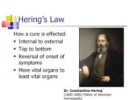 Question: What is Hering's Law?
Answer: Hering's Law states that: “All healing occurs from within out, from the head down, and in the reverse order in which the symptoms have appeared.”
Question: Who came up with Hering's Law of Cure?
Answer: Many years ago, a now famous Doctor observed this healing phenomenon and thus, this healing event was named after him, Dr. Constantine Hering (1800 - 1880) - Father of American Homeopathy.
Question: What does Hering's Law mean?
Answer: Hering's Law describes an event or process that may occur after you begin to detox or do a cleanse on your body, especially if you have cleansed too much and / or too fast. Essentially, the body will follow a certain pattern of healing as described below:
“From within-out” - getting rid of toxic accumulations from the inside of the body to the outside (through the skin).
“From the head down” - A good philosophy is part of getting well-a philosophy that brings cheerfulness, happy moments and an attitude of determination to overcome. Where is a person’s philosophy? The answer is in the head. The person who nurtures hate, destructive ideas, misery read more [...]
Question: What is Hering's Law?
Answer: Hering's Law states that: “All healing occurs from within out, from the head down, and in the reverse order in which the symptoms have appeared.”
Question: Who came up with Hering's Law of Cure?
Answer: Many years ago, a now famous Doctor observed this healing phenomenon and thus, this healing event was named after him, Dr. Constantine Hering (1800 - 1880) - Father of American Homeopathy.
Question: What does Hering's Law mean?
Answer: Hering's Law describes an event or process that may occur after you begin to detox or do a cleanse on your body, especially if you have cleansed too much and / or too fast. Essentially, the body will follow a certain pattern of healing as described below:
“From within-out” - getting rid of toxic accumulations from the inside of the body to the outside (through the skin).
“From the head down” - A good philosophy is part of getting well-a philosophy that brings cheerfulness, happy moments and an attitude of determination to overcome. Where is a person’s philosophy? The answer is in the head. The person who nurtures hate, destructive ideas, misery read more [...] CONIUM MACULATUM کونیم The essential features: Homeopathic Materia Medica VIVA by George Vithoulkas
CONIUM MACULATUM کونیم
Poison Hemlock.
N.O. Umbelliferae.
Tincture of fresh plant in flower.
THE ESSENTIAL FEATURES
The idea of paralysis in Conium is not so much the one we know from Socrates' death by the 'noggin of hemlock'; real paralysis comes only as an end result, and this may take a very long time, twenty years, thirty years, or more. Conium suffers with a gradually progressing weakness and paresis, and gradual is the key word here.
The idea is much more that of sclerosis, of becoming hard, especially the glands, which become swollen and indurated. A gradually progressing weakness with the formation of indurations during the decline, is the picture of Conium pathology.
Mental Paralysis and Induration
This process develops on all three levels. On the mental level, we observe a gradual decline of the intellectual capacities.
The patient becomes more and more dull; he has more and more difficulty in comprehension.
Thinking is slowed down, memory becomes weak, and the patient becomes forgetful. His five senses lose their acuity, and his reserves slowly ebb away. A frequent and characteristic symptom is an inability to sustain mental effort read more [...]
DIGITALIS – ڈیجیٹیلس The essential features: Homeopathic Materia Medica VIVA by George Vithoulkas
DIGITALIS - ڈیجیٹیلس
Digitalis purpurea. The foxglove.
N.O. Scrophulariaceae.
Tincture of the second year leaves.
THE ESSENTIAL FEATURES
Digitalis is primarily a heart remedy. It should be considered when the pulse is abnormally slow and later in the pathology, fast or irregular, intermittent; where there is heart disease, with great weakness, and the patient can hardly talk, and is losing strength to the point that he feels faint. Cold skin and irregular respiration will often point to such cardiac pathology. All this can be accompanied by deathly nausea and emptiness in the stomach; weakness and dilation of the myocardium; and prostration from the slightest exertion.
Digitalis will be indicated if you have been told by the patient that when the problem started (whether acute or chronic), the pulse was very slow, even down to 40 beats per minute. Hahnemann says that Digitalis 'greatly slows down the pulse in its primary action', and this initial slowing down of the pulse rate is a guiding symptom of Digitalis in almost all cases, no matter what the pathology.
It must be understood that here the heart is in a precarious state, is really read more [...]
ہومیوپیتھک کیس ٹیکنگ میں مشاہدہ Body language
باڈی لینگویج
کیس ٹیکنگ میں مشاہدہ کی بہت اہمیت ہے۔ اس بات پر غور کریں کہ مریض کیا کرتا ہے اور کیا کہتا ہے۔ مثلاً باڈی لینگوئج کو ہی لے لیں۔ برائی اونیا کا مریض بے حس و حرکت لیٹا ہو گا۔ سوالات کے جواب دینے سے گریز کرے گا۔
کالوسنتھ یا میگنیشیا فاس کا مریض ہو گا تو آگے کو دہرا ہوا ہو گا۔
جیلسی میم کا مریض ہو گا تو نقاہت اس کے انگ انگ سے پھوٹ رہی ہو گی۔ شکایت کوئی بھی ہو اگر علامات میں نقاہت بھاری ہو تو جیلسی میم کو کبھی نہ بھولیں۔
نکس وامیکا کا بیوروکریٹک رویہ آپ محسوس کریں گے۔ علامات بیان کرے گا تو انتہائی نفاست اور ترتیب سے۔ نکس وامیکا اور آورم میٹ کا اندازِ حکمرانی نمایاں ہوتا ہے۔ آپ نے دیکھا ہو گا بعض مریض کلینک میں آکر بیٹھ جائیں گے اور جب تک آپ اُن سے مخاطب read more [...]
HEALING CRISIS: The Road to Better Health (Walter Last)
I routinely recommended to my patients right on their first visit to adopt a high-quality, low-allergy diet. When they came back two or three weeks later, they often said that they feel much better now but a week ago they had a cold. When I asked about the symptoms they turn out to be mainly a profuse mucus discharge, sometimes also diarrhoea, but rarely are there signs of a real infection. In fact, these patients just experienced their first healing crisis on their long path to better health.
This concept of a healing crisis clearly shows the opposite perceptions that drug medicine and holistic medicine have of health and the healing process. In drug medicine it is assumed that a patient who is free of disease symptoms is more or less healthy and the aim of drugs is to achieve this condition by removing any disagreeable symptoms. Frequently alternative or complementary medicine is used in the same way, instead of more or less toxic drugs just more benign remedies are being used. This is what most patients want and according to their beliefs they either use drugs or natural remedies for this purpose.
However, holistic or natural medicine, following in the footsteps of the old read more [...]
 Hussain Kaisrani, The chief consultant and director at Homeopathic Consultancy, Lahore is highly educated, writer and a blogger